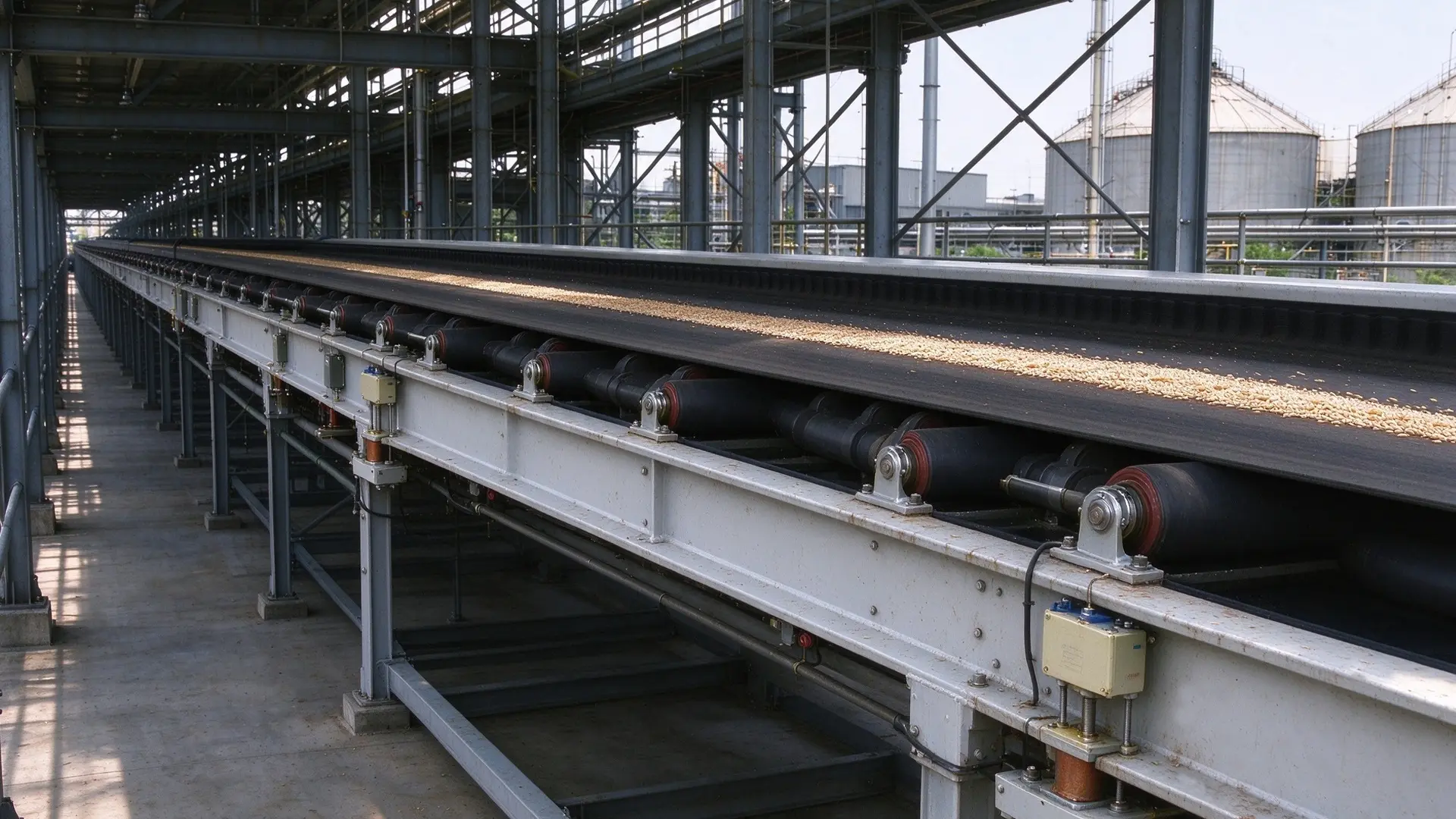
Belt Weigher image

Belt Weigher

Long-Term Maintenance-Free Stability

Highlights

  • Pioneering OIML Class 0.2 Trade-Grade Certification.
  • Eliminate belt effect errors.
  • Lightweight Single-Point Suspension Structure.
  • IoT Remote Expert Diagnostic System.

Performance Features

01

Internal Force & Belt Effect Compensation

Traditional belt weigher suffer from severe measurement drift caused by fluctuating belt tension and stiffness ('belt effect'). The belt weigher that we provided implements a continuous array array of independent weighing units. Within the array, belt tension forces cancel each other out as 'internal forces', while real-time sensor sampling compensates for belt rigidity variations, ensuring long-term error <=0.2%.

02

Single-Point Array Units & Easy Installation

Abandoning bulky, heavy lever frames, each array unit utilizes a single specialized load cell supporting two sets of idlers directly mounted on the conveyor stringers. The lightweight, anti-eccentric design eliminates frame deformation and idler material buildup, significantly reducing installation downtime and eliminating daily mechanical maintenance.

03

Specialized Load Cells & Speed Sensors

Every single load cell undergoes rigorous 48-hour environmental temperature testing to map creep and sensitivity factors into the digital processing unit. Coupled with a double-spoke top-mounted speed encoder, the system accurately tracks dynamic belt speed without slip or angular errors.

04

Intelligent Control & IoT Tele-Diagnostics

Equipped with the system featuring local RTU field signal acquisition and a PTU color touchscreen terminal. Integrated IoT protocol enables seamless cloud connectivity, recording over 100 operating parameters, auto-deleting anomalous sensor channels, and granting expert remote diagnostics anytime, anywhere.

FAQ

How does the belt weigher achieve OIML 0.2 trade-level accuracy while traditional belt scales drift?
Traditional belt scales rely on a single heavy scale frame, making them extremely sensitive to belt tension changes, frame distortion, and idler misalignment. The belt weigher uses an array of independent single-point units. Belt tension acts as an internal force that cancels out across adjacent units, while mathematical algorithms compensate for belt rigidity, keeping operational error strictly <=0.2%.
How does the IoT Remote Expert Diagnostic System assist in daily maintenance?
This system connects the field RTU directly to cloud expert servers via GPRS/Ethernet, tracking over 100 operating parameters in real-time. If an individual sensor or idler develops an anomaly, the system automatically detects, alerts, and isolates the fault unit without stopping the conveyor, providing early warnings to engineers.
Can the belt weigher be integrated into mobile shiploaders and train loadout stations?
Yes. We offers the mobile belt weigher variation specifically designed for variable-angle conveyors on stacker-reclaimers and shiploaders. Combined with three-dimensional attitude tracking technology, it eliminates angle-tilt errors and integrates seamlessly with PLC-driven Z-600 automated train/ship loading systems.
Does the belt weigher require complex physical recalibration with real material?
No. Due to the elimination of belt tension and belt rigidity interferences, the system offers revolutionary long-term stability. Users can perform daily zero/span calibration using simple hanging weights or the optional SA-600 automatic hanging weight system, eliminating the need for frequent, costly real-material calibration trips.

Engineer your Belt Weigher with GSS

Tell us your request — we will determine the right configuration and send a proposal.

We typically respond within 1 business day. Your information is only used to follow up on your inquiry.