

How to Choose a Curved Conveyor for Bulk Materials
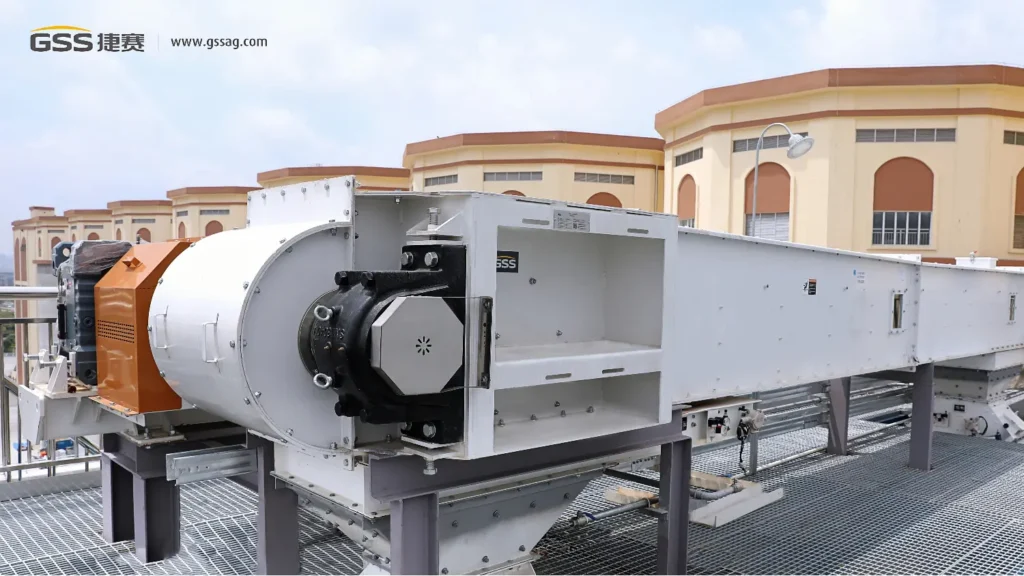
In bulk material conveying system, curved conveying brings real benefits to process design in terms of space utilization, equipment savings, and reduced steel structure investment.
This guide provides an engineering comparison of the three primary curved conveying technologies: Pneumatic Conveying, Tubular Chain/Cable Conveyors, and Pipe Belt Conveyors, followed by a structured selection framework.
1. Pneumatic Conveying
Pneumatic conveying uses air or inert gas as a carrier medium, leveraging the airflow thrust generated by the pressure difference between the inlet and outlet to drive bulk materials through closed pipelines.
Drive configurations
- Vacuum (negative pressure): a vacuum pump draws material and air into the line together. Best for multi-point suction feeding into a single destination, typically within 50 m.
- Positive pressure: compressed air pushes material through the pipe. Best for single-source distribution to multiple destinations, up to 200 m in dilute phase and up to 2,000 m in high-pressure dense phase.
- Combined vacuum-pressure: Combines suction intake with pressure discharge for flexible multi-point routing.
Key Advantages
Flexible routing, strong adaptability, long conveying distance, relatively sealed system.
Little risk of foreign parts such as bolts or contaminants falling in during conveying.
Low cost, short construction period, easy to implement and install.
Limitations
High noise and energy consumption, prone to dust escape, poor operating environment.
Prone to blockage and pipe wear-through, especially at bends; difficult maintenance.
Material degradation (particle breakage) and segregation during conveying.
Explosion risk in high-dust environments.
Ideal Applications
Regular small-diameter granules with low moisture, low bulk density, and low cohesiveness.
Materials requiring cooling or heating during transfer.
Hazardous chemical raw materials — can be conveyed with inert gas.
Unsuitable Materials
Hygroscopic, sticky, or high-moisture materials.
Large-particle, high-bulk-density, poor-flowing, or irregular-shaped materials.
Highly abrasive materials.
2. Tubular Chain/Cable Conveyors
Tubular chain/cable conveying involves a gear motor driving a chain inside an enclosed pipe; circular discs attached to the chain push the bulk material along, enabling horizontal, vertical, and curved conveying.
Drive System Options
- Loop Chain Drive: Uses sprockets meshing with a heavy-duty chain. Exceptionally rugged, supporting harsh environments, high temperatures (up to 200℃), abrasive materials, and integrated self-cleaning systems.
- Steel Cable Drive: Uses disc flights fixed to a wire rope. Designed for ultra-high cleanliness, minimal material residue, advanced automated sanitation (air purge, hot water wash, thermal sterilization), and extremely fragile materials.
Industry Note: Advanced suppliers like GSS manufacture industrial-grade tubular chain/cable conveyors for sensitive materials, including soy flakes, meal, flour, starch, rice, malt, pet food, pharmaceuticals, and dried sludge.
Key Advantages
- Flexible Layout: Free 3D spatial curve routing to meet complex process design requirements.
- Fully Enclosed Conveying: Dust-tight, zero-emissions design that prevents environmental contamination.
- Gentle & Quiet Operation: Minimizes degradation and breakage, ideal for fragile and friable materials.
- Maintenance-Free Intermediate Sections: Significantly reduces structural steel investment and footprint.
- Versatile Discharge Options: Supports multi-point feeding, multi-point discharge, and simultaneous multi-point discharge.
- Modular Design: Enables easy retrofitting, layout re-engineering, and future scheme adjustments.
Limitations
- Limited Throughput: Currently capped at a maximum throughput of 60 m³/h, making it suitable primarily for small-to-medium capacity applications.
- Material Sensitivity: Not suitable for materials with high moisture content, high stickiness/tackiness, strong hygroscopicity, or poor discharge flowability.
- Higher Initial Cost: Requires customized engineering and bespoke manufacturing drawings tailored to each specific project layout.
3. Pipe Belt Conveyor
Pipe belt conveyor is developed from conventional trough belt conveyors. It uses dynamic sets of idlers arranged in a regular polygon to force the conveyor belt into a closed tubular shape, enabling the enclosed, continuous transport of various materials in powder, granular, or lump form.
Widely used in industries such as grain handling, power generation, coal, mining, steelmaking, and port terminals, it is primarily deployed in complex, long-distance conveying environments to achieve ultra-long-distance, high-capacity transport. Generally, a single conveyor unit can reach a conveying distance of 5–7 km, with a maximum throughput capacity of up to 7,200 m³/h.
Industry Note: GSS pipe belt conveyor systems excel in port loading and unloading, intra-plant logistics, long-distance overland conveying, and applications requiring low noise and high cleanliness standards. It is also particularly well-suited for conveying fragile agricultural commodities such as corn and paddy rice.
Key Advantages
- Flexible Spatial Layout: Features 3D spatial curved routing capabilities.
- Long-Distance & High-Capacity Conveying: Eliminates the need for intermediate transfer sections, saving on investment and maintenance costs for auxiliary equipment.
- 3D Terrain Adaptability: Ideal for cross-country and overland routes where buildings or unmovable obstacles are present along the path.
- Enclosed & Eco-Friendly Conveying: Achieves dust-tight, enclosed transport of bulk materials without requiring an external gallery or enclosure.
- Bi-Directional Conveying: The return strand can also form a pipe shape to convey material simultaneously, achieving bidirectional transport.
- Low Noise & Low Maintenance: Designed for quiet operation with reduced wear and tear.
- Minimal Civil Infrastructure: Does not require heavy structural steel support framing, requiring only simplified steel trestles and structures.
Limitations
- Unsuitable for Short Distances: Requires a specific transition distance at the head and tail sections to transition the flat belt into a tubular form and vice versa.
- Large Turning Radius Constraints: The horizontal/vertical curve radius is directly proportional to the pipe diameter, making it unsuitable for tight or highly confined spaces.
- Material Stickiness Limitations: Not suitable for highly sticky or tacky materials that adhesive to the belt.
- Complex Operational Resistance Dynamics: Running resistance increases significantly with speed; selecting the exact running resistance coefficient in the engineering design is complex and requires suppliers with strong, proven technical expertise to ensure reliable equipment execution.
4. Comparison of 3 Curved Conveying Methods
| Comparison | Pneumatic Conveying | Tubular Chain / Cable Conveyors | Pipe Belt Conveyors |
| Max. Capacity | 40m³/h | 60m³/h | 7200m³/h |
| Max. Single-Unit Distance | Positive pressure: 200 m, Vacuum (negative pressure): 50 m | 100m | 15000m |
| Recommended Applications | Low bulk density, low-value, low-budget powder materials, or materials requiring cooling | Small capacity, fragile/friable, fully enclosed, high-hygiene material handling | Fragile materials, medium-to-large capacity, long-distance overland transport, and complex outdoor environments |
| Maintenance | Complex: Prone to pipe wear-through and clogging | Easy | Easy |
| Key Advantages | Easy implementation, low initial capital investment | Superior hygiene/cleanliness, low particle degradation, high reliability | Scalable capacities, high versatility, reliable and stable operation |
| Key Disadvantages | High energy consumption, high material breakage/degradation | Higher upfront investment cost | Large footprint required at head and tail sections |
| Total Cost of Ownership (TCO) | High | Low | Low |
5. How to Choose the Right Flexible Curved Conveying System?
No conveying technology is universally better than the others; each one wins on a different axis. To choose the optimal flexible curved conveying system for your processing plant, evaluate these three core criteria:
- What are the material characteristics?
- What is the throughput?
- How long and complex is the route?
For low throughput, complex 3D routing, and strict cleanliness or low-breakage requirements, a tubular chain conveyor is the first choice.
For long-distance, high-capacity conveying across complex outdoor terrain, the pipe belt conveyor is often the only economical option.
When materials are dry and light, with multi-point pickup or inert-gas protection needs, pneumatic conveying remains irreplaceably flexible.