

Which Chain Should a Drag Conveyor Use in Bulk Handling?
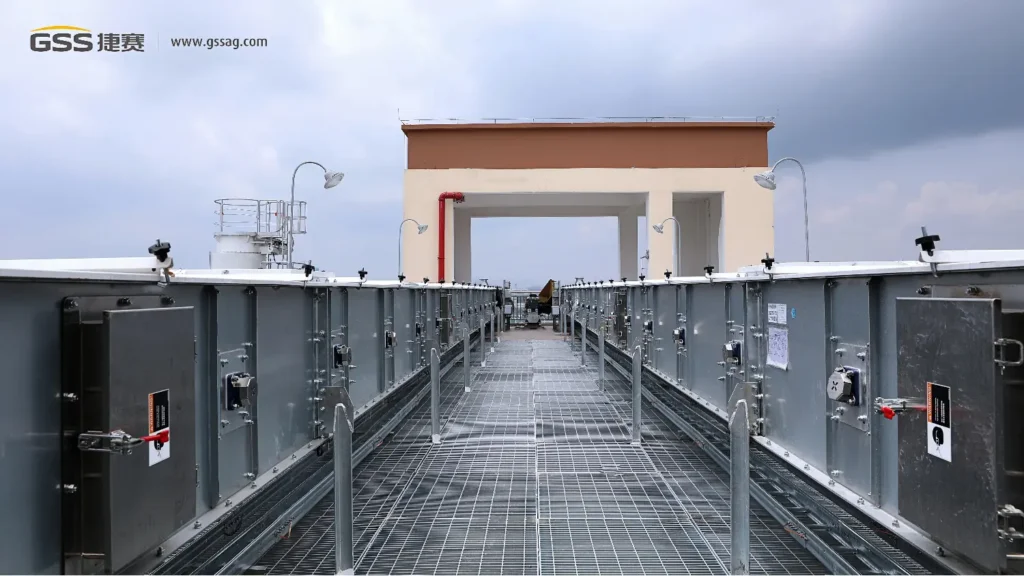
In grain and oil processing plants, the chain is the component that decides a drag conveyor’s uptime, wear life, and long-term operating costs. Four chain types dominate these en-masse conveyors: drop-forged chains, sleeve roller chains, welded cranked-link chains, and sleeve cranked-link chains. The right chain for drag conveyor depends on your material, load, and operating environment.
What the Chain Does in a Drag Conveyor?
A drag conveyor (also called an en-masse conveyor or scraper conveyor) moves bulk material as a slow, contained stream: the chain, fitted with flights, pulls material along a enclosed trough. In doing so, the chain works under three simultaneous wear mechanisms: engagement with the sprocket, sliding or rolling against guide rails, and abrasion from the material itself.
Chain selection therefore determines:
- Uptime – a broken chain stops the entire line.
- Wear life – pin, bushing, and sprocket wear rates differ sharply between chain types.
- Operating cost – purchase price, replacement labor, and how the chain interacts with sprockets and wear-resistant liners.
Four engineering chains are used in drag conveyors for grain and oil handling. Each has a distinct structure, heat treatment route, and set of trade-offs.
Drop-Forged Chains: High Strength in a Compact, Lightweight Package
Drop-forged chains feature a compact architecture, light weight, and minimal material carryback. They consist of forged links, pin shafts, retaining rings, and chain attachments.
- Manufacturing & Heat Treatment: Links are precision-forged from alloy steels (typically 40Cr or 20CrMnTi). They are treated via quenching/tempering or carburizing to establish high surface hardness while preserving core toughness.
- Strengths: Excellent strength-to-weight ratio; high surface hardness and strong overall mechanical properties; smaller pitch and lower weight; high fatigue resistance; minimal material carry-over; reliable performance under high loads and aggressive wear conditions.
- Limitations: Higher overall cost and longer production lead times; sliding friction against sprockets and wear strips demands durable companion materials.
- Best Suited For: Applications demanding high wear resistance and high strength, lighter-duty scrapers, and conveying duties where minimal residual material on the chain is required.
Sleeve Roller Chains: Low Cost and Long Life in Clean, Light-Duty Duty
A sleeve roller chain (bushing roller chain) is assembled from inner link plates, outer link plates, bushings, pins, rollers, and attachments.
The link plates are cut and precision-machined; rollers are fitted over the bushings, which are press-fitted into the inner plates; the outer plates connect via pins. Attachments can be welded or bolted on, which makes them replaceable and adaptable to different materials.
- Manufacturing & Heat Treatment: Link plates, rollers, and pins are commonly 40Cr, quenched and tempered. The design is highly standardized, simple to machine, and cost-effective.
- Strengths: Rolling friction with sprockets and guide rails minimizes drive torque, which reduces joint pressure and enables low wear, long service life, and low friction losses.
- Limitations: Multi-part press-fit assembly yields lower ultimate tensile strength compared to forged options. Inner and outer link sections must be replaced in pairs, which raises maintenance complexity and cost. At equal strength it is significantly heavier than the other chain types.
- Best Suited For: Relatively clean conveying environments handling large-volume, lightweight, low-adhesion materials. Not recommended where corrosive conditions or heavy dust and fines are present.
Welded Cranked-Link Chains: The Mainstream Choice for Grain and Oil Conveying
A welded cranked-link chain is built from cranked links, pin shafts, pins, and attachments, with the bushing welded into the cranked link plate. Its simple structure and balanced overall performance have made it the most widely used engineering chain in drag conveyors.
- Manufacturing & Heat Treatment: Link plates and sleeves (40Cr) are welded into integral link units. Plates and pins quenched and tempered with surface hardening for wear resistance; bushings hardened by high-frequency induction hardening. Some designs apply localized induction hardening to the wear faces of the link plates. Attachments are usually welded to the links.
- Strengths: The all-welded construction gives the chain excellent structural strength and high resistance to heavy loads and shock. Heat treatment of the chain body delivers high wear resistance.
- Limitations: The welding process prevents the bushing from receiving carburizing or inner-bore induction hardening, and welded attachments cannot be separately strengthened. Over time, bushing wear and attachment breakage are prone to occur.
- Best Suited For: Heavy-duty, high-capacity grain and oilseeds conveying involving shock loads, abrasive dust, or sticky materials like soybean meal.
Sleeve Cranked-Link Chains: Maximum Bushing Wear Resistance at Low Speed
A sleeve cranked-link chain consists of bent (cranked) link plates, bushings, pin shafts, and pin-fixing parts such as pins and retaining rings. The bushings are press-fitted into the plates. Link plates and bushings are typically 40Cr.
- Manufacturing & Heat Treatment: Allows individual heat treatment of every component prior to assembly, enabling complete internal and external carburizing/induction hardening of the sleeve.
- Strengths: Each part can be heat-treated individually – the bushing in particular can be induction hardened or carburized on both its inner and outer surfaces, which multiplies its wear capacity compared.
- Limitations: Fine clearance gaps between components can trap fine dust or moisture, risking premature joint binding, corrosion, or pin shearing in dirty environments.
- Best Suited For: Conveying operations that demand maximum bushing wear resistance, heavy loads, and low chain speed, with non-powdery, non-corrosive materials.
Comparison of the 4 Types of Conveyor Chains
The table below consolidates the structural, material, and cost comparison of the four conveyor chain types, based on manufacturing analysis, materials and heat-treatment data, and field testing.
| Item | Drop-Forged Chain | Sleeve Roller Chain | Welded Cranked-Link Chain | Sleeve Cranked-Link Chain |
| Material | Case hardening steel / Q&T steel | Q&T steel | Q&T steel | Q&T steel |
| Pitch at equal strength | Small | Large | Small | Small |
| Sprocket teeth at equal material layer height | More | Fewer | More | More |
| Dynamic load at equal material layer height | Low | High | Low | Low |
| Chain weight at equal strength | Light | Heavy | Relatively light | Relatively light |
| Maintenance convenience | Easy | Complex | Easy | Easy |
| Material utilization | Low | High | High | High |
| Manufacturing process | Demanding | Moderately demanding | Simple | Simple |
| Overall chain cost | High | Relatively high | Low | Relatively low |
Application Guidelines
Matching the right chain to specific materials and operating environments is an essential measure for extending chain service life and reducing maintenance costs.
- Drop-Forged Chain: Commonly used in lightweight drag conveyors or applications with high wear resistance requirements. It is also suitable for conveying conditions where minimal material residue on the chain is required.
- Sleeve Roller Chain: Best suited for clean operating environments and low-cohesion, bulky, lightweight materials.
- Welded Cranked-Link Chain: Suitable for continuous, high-capacity conveying of diverse materials, as well as dusty or sticky materials such as soybean meal.
- Sleeve Cranked-Link Chain: Designed for operating conditions that demand higher sleeve wear resistance.
In practical applications, sleeve cranked-link chains are higher in cost, offer fewer standard models, and see lower market demand. Welded cranked-link chains hold clear advantages in fatigue resistance, strength, service life, and cost efficiency, making them the primary choice in the grain and oilseed conveying sector today – which is why GSS drag conveyors also adopt high-performance welded cranked-link chains as standard equipment.