

Bridging the “Last Mile” from Ships to Silo with GSS Air-Supported Belt Conveyors
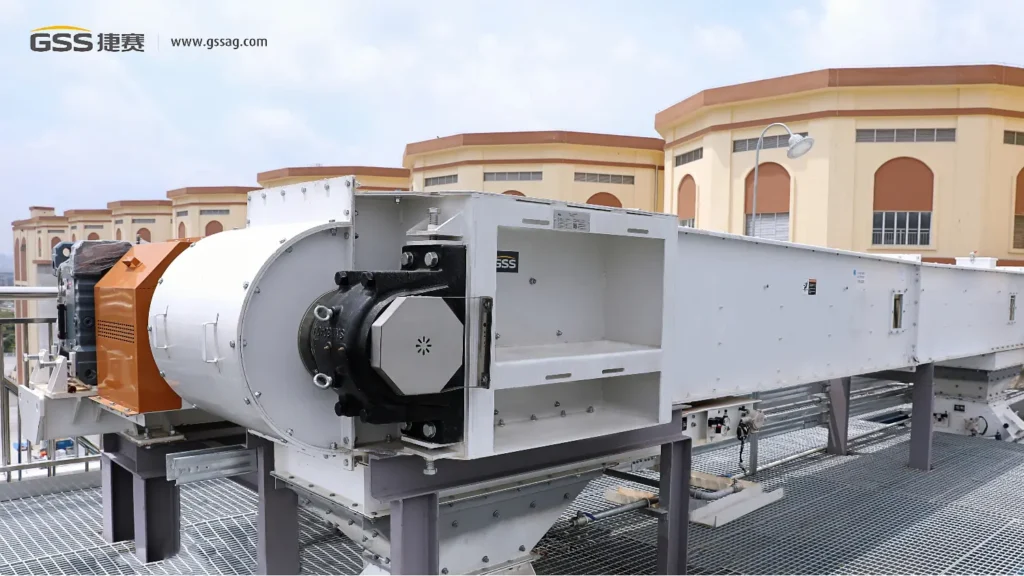
In the bulk grain transport chain, the “last mile” from ship unloading to silo storage has long relied on truck transfers—a process plagued by low efficiency, high material loss, and heavy dust emissions.
The air-supported belt conveyor, featuring a structural innovation that replaces traditional idlers with a thin layer of air, is rapidly becoming the leading solution for modern ports to overcome this logistics bottleneck.
Why Air-Supported Belt Conveyors Are Needed?
1.1 Pain Points of Traditional Truck Haulage
In port bulk grain logistics, relying on truck haulage to move grain from wharf to factory storage silos faces four major challenges:
- Low Efficiency: Traditional truck haulage caps daily throughput at roughly 4,000 tonnes, falling to meet the continuous processing demands of large-scale grain and oil facilities.
- Material Losses: Bulk grain is prone to breakage and spillage during multi-stage handling, resulting in direct financial losses.
- Dust Pollution: Open transport makes it difficult to meet the strict environmental standards of green ports and clean facilities.
- High Operational & Labor Costs: Ongoing investments in fleet dispatching, drivers, and fuel drive up overall logistics overhead.
1.2 Why Air-Supported Belt Conveying is the Superior Solution?
Overcoming the efficiency limits of truck haulage requires a fully enclosed, continuous, high-capacity conveying system that directly connects the wharf to factory storage silos. This is precisely where the air-supported belt conveyor excels. It not only solves the “last mile” link, but also outperforms traditional conveyor equipment in energy savings, environmental protection, and material integrity.
How Air-Supported Belt Conveying Works?
The core mechanism of an air-supported belt conveyor replaces traditional idlers with a uniform, stable layer of air (an air cushion) to smoothly suspend both the belt and the material above it. The conveyor belt and its payload “float” along the trough on this air film rather than rolling over mechanical idlers.
This principle operates across three key stages:
- Air Supply: An integrated blower and dust collection unit continuously feeds stable pressurized air into the plenum chamber, forming a thin layer of air between the belt and the trough shell.
- Uniform Suspension: The air cushion distributes evenly along the conveying route, supporting the belt and material for smooth operation.
- Closed-Loop Air Purification: The system creates an internal air circulation loop, continuously filtering internal dust while supplying air.
The air-supported belt conveying system is a comprehensive solution that integrated with multiple patented technologies:
- Buffer Feed Hoppers: Ensure uniform material loading and eliminate impact damage.
- Smart Sensor: Provide real-time monitoring of key parameters including material flow, belt deviation, and temperature.
- Comprehensive Safety Mechanisms: Combine mechanical and electrical protection to build a fully intelligent management system for continuous, stable operation.
What are the advantages of Air-Supported Belt Conveyors?
Advantage 1: Substantial Energy Savings & Cost-Effective Operations
Because the belt and material float on an air cushion, frictional resistance is drastically reduced, lowering total energy consumption by more than 35% compared to conventional idler-based equipment, especially in long-distance, high-capacity applications above 2000t/h.
Advantage 2: Smooth Operation & Gentle Material Handling
A vibration-free, smooth transition minimizes grain degradation and dust creation. This makes air-supported belt conveyors ideal for fragile or cleanliness-sensitive bulk products like grains, fertilizers, and plastic pellets.
Advantage 3: Simplified Maintenance & Extended Lifespan
The number of rotating parts in the system has been drastically reduced, eliminating potential failure points such as idler damage and bearing jams. This significantly lowers the daily maintenance workloads and costs while increasing the lifetime reliability.
Advantage 4: Fully Enclosed & Eco-Friendly
Featuring a fully enclosed design, the conveying process prevents dust leakage, easily satisfying the stringent environmental standards for green ports and clean factories. Combined with the internal air purification system, it achieves a perfect balance between throughput performance and environmental compliance.
Application Case of GSS Air-Supported Belt Conveyor System
GSS has successfully delivered a 1,400-meter air-supported belt conveyor system at the Yueqing Bay Port Area of Wenzhou Port. Engineered specifically for Yihai Kerry’s grain & oil processing base, the system seamlessly connects the wharf to factory storage silos, achieving fully enclosed, continuous grain conveying for the port’s “last mile.”
| Metric | System Data / Performance |
| Conveying System Length | 1,400 meters |
| Rated Capacity | 500 t/h |
| Efficiency vs. Truck Transport | >3x Increase |
| Annual Throughput | Up to 4.5 Million Tonnes |
| Service Region | Southern Zhejiang & Northern Fujian |
This system serves as a key logistics engine for grain conveying across southern Zhejiang and northern Fujian regions, proving the large-scale industrial capabilities of air-supported conveyor technology in port bulk handling.
Conclusion
Connecting the bulk grain “last mile” from ships to silos transforms port logistics by increasing throughput speeds, reducing environmental burdens, and lowering operational costs. GSS continues to drive technological innovation, delivering safer, greener, and more efficient bulk material handling solutions to global industrial clients.