

How to Get Best Balance Between Efficiency and Environment in Port Logistics?
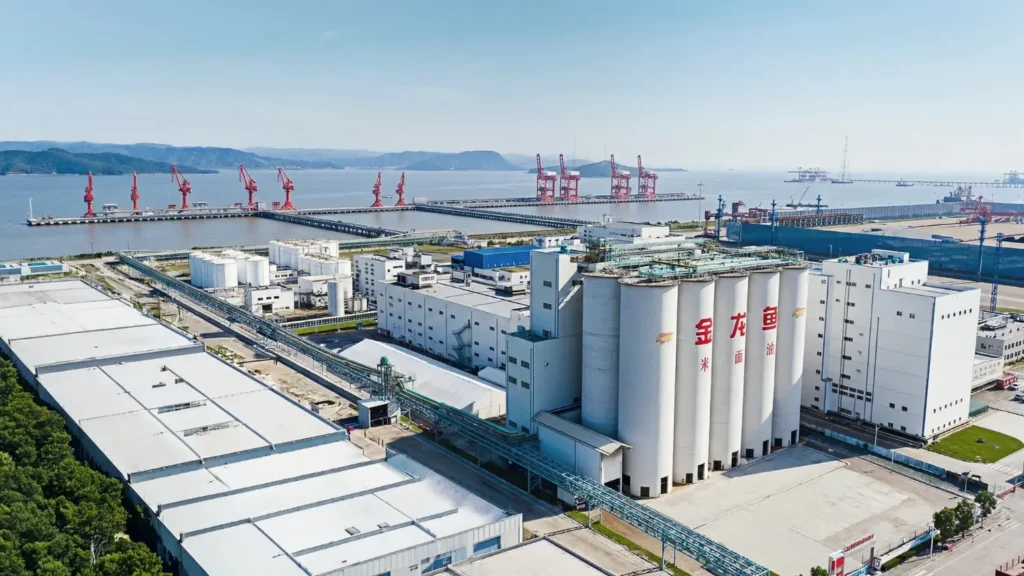
Port-side bulk logistics and handling – specifically unloading and transfer operations – faces an inherent dilemma in efficiency, environmental compliance, and reliability. Neither traditional batch unloading nor conventional continuous methods fully resolve these operational bottlenecks.
By employing a core design featuring “dynamic, fully enclosed continuous unloading,” the GSS Continuous Intake Belt Conveyor has successfully overcome traditional limitations, providing safer, eco-friendly, and highly efficient bulk material handling solutions for global ports and industrial terminals.
The Dilemma of Traditional Bulk Ship Unloading Methods
Current mainstream solutions in port bulk handling exhibit persistent bottlenecks that remain challenging to address:
1.1 Batch Unloading (Grab Type Ship Unloader + Fixed Hopper)
- Low Efficiency: Dependent on cyclic grab buckets, these systems operate in an intermittent, batch-by-batch process mode rather than continuous conveying, inherently limiting overall throughput capacity.
- Environmental Non-Compliance: Unloading operations are highly prone to material spillage and severe dust emissions – particularly without effective dust suppression systems – leading to substantial environmental pollution and failing to meet increasingly stringent green standards.
- High Costs & Operational Risks: These systems rely heavily on skilled manual labor;enormous energy consumption from repeated grab lifting; and significant safety hazards arising from falling materials and the mechanical impact from the grab buckets onto the portal cranes.
1.2 Matching Difficulties in Continuous Unloading Systems (Ship Unloaders & Conventional Cover Belt Conveyors)
- Open-Belt Conveyors: If open belt conveyor is used downstream, severe dust emissions occur at the transfer points, making it environmentally unfriendly.
- Dual Air-Cushion Belt Conveyors: While helpful for dust suppression, they cannot accommodate the mobile discharging required by ship unloaders, resulting in insufficient operational flexibility.
- To pursue continuous conveying, some scenarios pair ship unloaders with traditional cover belt conveyors; however, this introduces a new set of challenges:
- Sealing Difficulties and Dust Generation: Traditional cover belt conveyors rely on bend pulleys to lift the cover belt and create an inlet. The inlet is large and difficult to seal, often turning the feed point into a new source of dust pollution.
- Poor Operational Stability: As ship unloaders move along operations, the cover belt is highly prone to deviation on the bend pulleys. This not only compromises conveying stability but also severely accelerates equipment wear and tear.
- Structural Flaws & High Maintenance: Conventional cover belts lack sufficient rigidity, making them prone to water pooling, sagging, and edge curling that leads to leaks. Furthermore, they cannot be effectively secured along the conveyor direction, creating risks of being flipped over by strong winds. Heavy cover belts are arduous to restore, driving up long-term operation and maintenance (O&M) costs.
GSS Continuous Intake Belt Conveyor: Three Core Technological Breakthroughs
Targeting the stubborn industry ailments of traditional bulk unloading, GSS Systems innovatively developed the Continuous Intake Belt Conveyor, finding the best balance between high-efficiency continuous conveying and superior environmental performance.
2.1 Continuous Intake for Superior Efficiency
- Boat-Shaped Zipper Inlet: Featuring a patented design that operates like an intelligent zipper, it dynamically tracks the discharge points to achieve precise opening and closing. Operating smoothly without downtime or manual intervention, it ensures continuous intake and completely eliminates the throughput bottlenecks associated with batch unloading.
- High-Elasticity Flexible Opening & Closing: Paired with high-elasticity, wear-resistant cover belts, the mechanism enables flexible opening and closing as it moves. Even under heavy-volume, high-drop harsh ship unloading conditions, it guarantees continuous and uniform material intake, delivering operational efficiency far superior to traditional handling modes.
2.2 Dynamic Sealing for Environmental Protection
- Active Sealing: Instead of “passive sealing” of traditional cover belts and fixed belt covers, GSS continuous intake belt conveyors achieve active sealing through the belt-lapping mechanism. Once the bulk material passes through, the belt-lapping mechanism resumes lapping of the separated cover belts, creating a fully enclosed conveying environment.
- Pollution Control at the Source: Dust, moisture, and impurities are completely blocked out. Environmental performance metrics significantly surpass national and industry standards. While effectively minimizing windage loss and protecting material quality, it fundamentally improves the working conditions for operators.
2.3 Stable & Reliable Operation
- Dual Protection Mechanism: A protective drip edge (rain eaves) and the intake chute mechanism form dual protection, effectively shielding outdoor operations from rain, snow, wind, and sand. This ensures material materials enter the conveyor belt centered, uniform, spill-free, and clog-free.
- Wind-Resistant & Anti-Deviation: The cover belts are made of high-elasticity, wear-resistant composite material that offers both flexibility and structural strength. Two inclined elastic cover belts are arranged along the belt conveyor in lapping form. This eliminates wind-flipping risks in strong winds while simultaneously eliminating deviation issues.
- Modular Design for High-Compatibility: Featuring a modular design, the system is fully compatible with air-supported belt conveyors and various idler-supported belt conveyors. It allows for convenient on-site retrofitting while maintaining the original conveying capacity, significantly lowering equipment adaptation and modification costs.
GSS Continuous Intake Belt Conveyor has successfully passed the rigorous tests of 10,000-ton-grade continuous bulk material conveyance. Backed by its stable, reliable dynamic sealing performance and exceptional dust-suppression efficacy, it has won widespread market acclaim.